
.svg)
Date Published

January 5, 2026
Time to Read
.svg)
6 min
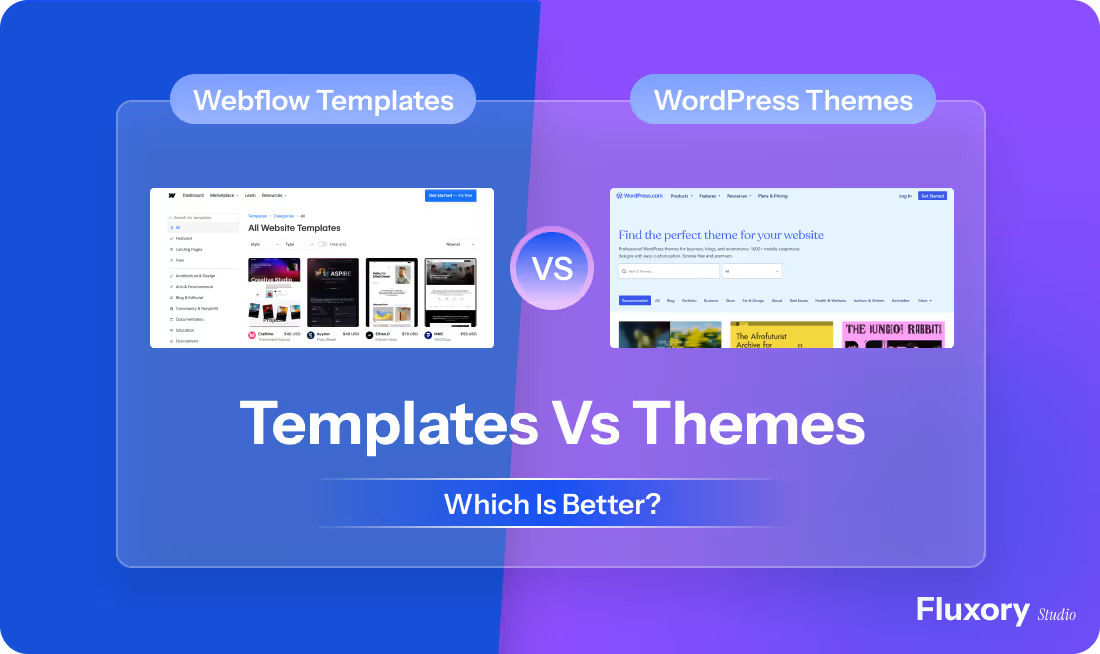
Comparing Webflow templates vs WordPress themes is not just about choosing a design system. It’s about how fast you can launch, how much control you have, and how scalable your website will be in the next few years.
In 2026, websites are no longer just online brochures. They are products, conversion machines, and brand assets. This shift is exactly why more designers, agencies, and SaaS founders are moving away from WordPress themes and choosing Webflow templates instead.
This comparison focuses on one question that actually matters, “Which platform helps you build better websites with less friction and more long-term value?”
Before going deeper, here is a quick side-by-side overview to set the context clearly.
| Feature | Webflow Templates | WordPress Themes |
|---|---|---|
| Design control | Full visual control | Limited by theme and plugins |
| Performance | Fast by default | Depends on hosting and setup |
| SEO foundation | Clean, structured HTML | Plugin-dependent |
| Maintenance | Fully managed | Manual updates required |
| Scalability | Ideal for modern websites | Plugin bloat over time |
| Best for | SaaS, agencies, portfolios | Blogs, content-heavy sites |
This table alone explains why the gap between Webflow and WordPress is widening in 2026.
Webflow templates are built for creators who want precision. Every layout, spacing choice, animation, and interaction can be controlled visually without relying on third-party builders.
With WordPress themes, design freedom is often an illusion. You start with flexibility, but quickly hit limitations imposed by the theme structure or the page builder. Achieving a truly custom design usually means adding CSS, extra plugins, or developer support.
In contrast, Webflow templates let you design exactly what you want. This is why agencies prefer Webflow when branding and conversion design matter.
Speed is not optional anymore. Google rewards fast websites, and users leave slow ones instantly. Webflow templates are hosted on an optimized infrastructure with clean code output. There is no plugin overload, no conflicting scripts, and no unnecessary bloat. Performance is consistent without extra setup.
WordPress performance depends on too many variables. Hosting quality, caching plugins, theme optimization, and plugin conflicts all affect speed. While WordPress can be fast, it requires continuous effort to keep it that way.
For teams who value reliability, Webflow templates remove this entire headache.
Both platforms can rank, but they take very different paths.
Webflow templates generate clean HTML, proper heading hierarchy, and mobile-first layouts by default. SEO basics like meta titles, descriptions, alt text, and schema control are native to the platform.
WordPress relies heavily on SEO plugins. While tools like Rank Math and Yoast are powerful, they add complexity and dependency. SEO becomes something you manage, not something that is structurally built into the site.
In 2026, simplicity and technical cleanliness are strong ranking signals. This favors Webflow templates.
One of the biggest long-term differences appears after launch.
Webflow handles hosting, security, updates, and backups automatically. Your website remains stable without ongoing maintenance tasks.
WordPress themes require constant updates. Core updates, theme updates, plugin updates, and security patches are all your responsibility. Over time, this increases risk, cost, and technical debt.
For businesses and creators who want to focus on growth instead of maintenance, Webflow templates are the safer option.
Webflow templates are the best choice if you are building:
These use cases benefit directly from Webflow’s design control and performance stability.
WordPress themes still make sense for:
This does not make WordPress bad. It simply makes it less suitable for modern, design-driven websites.
Ask yourself three simple questions:
If your answer is yes, Webflow templates are the better choice in 2026.
WordPress themes still serve a purpose, but Webflow is built for where the web is going, not where it has been.
The debate between Webflow templates vs WordPress themes is no longer balanced.
Webflow templates offer cleaner design systems, better performance, stronger SEO foundations, and far less maintenance. They are built for modern businesses, not legacy workflows.
If you are serious about building websites that look better, load faster, and scale smoothly, Webflow templates are not just an alternative. They are the upgrade.
Explore professionally built Webflow templates and start building websites that are ready for 2026 and beyond.
One email a month. New templates, and notes on shipping faster.
.svg)

.svg)

.svg)

.svg)


.png)
© Fluxory Studio 2026. All rights reserved
.png)


