
.svg)
Date Published

February 23, 2026
Time to Read
.svg)
6 min
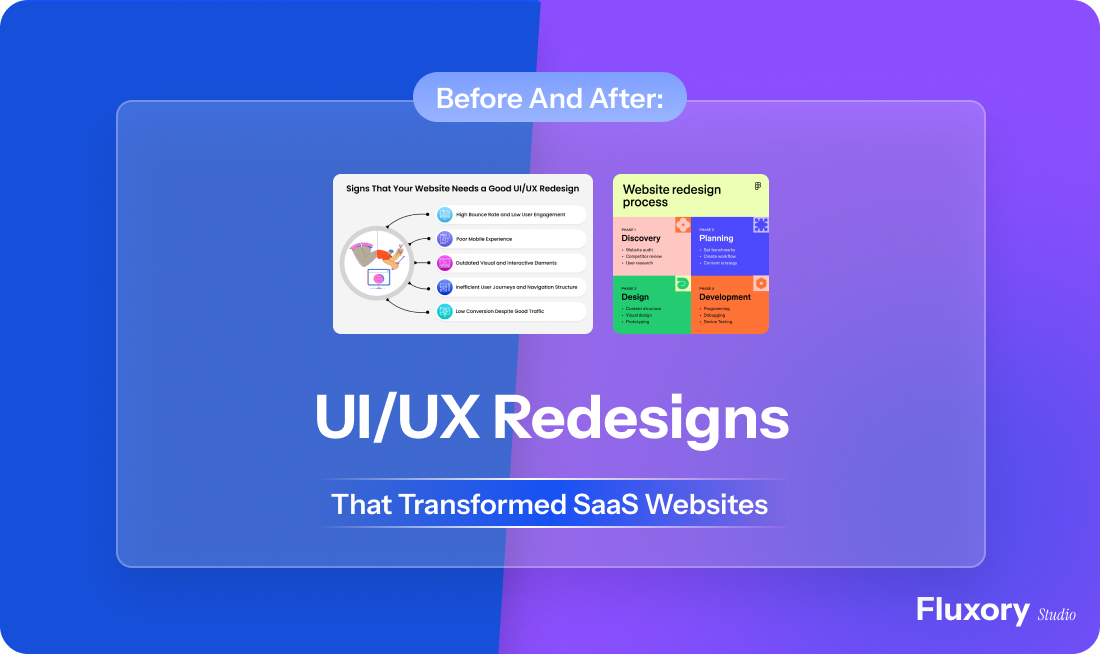
The success of a SaaS product is often defined by how users interact with it. Even the most powerful features can go unnoticed if the user interface is confusing or the experience is frustrating. This is where UI/UX design for SaaS comes into play. A well-thought-out redesign can transform not only the look of a website but also user engagement, conversions, and retention.
In this article, we explore real examples of SaaS websites that underwent UI/UX redesigns, showing the impact of thoughtful design improvements. If you have some knowledge about UI/UX, this guide will help you understand why a redesign could be the turning point for your product.
Users form an opinion about your SaaS website within seconds. A cluttered interface, confusing navigation, or inconsistent design can make visitors leave before exploring your product. UI/UX design ensures that your website is intuitive, visually appealing, and aligned with the user’s expectations.
For SaaS companies, where onboarding and trial conversion are critical, UI/UX design is not just aesthetic. It directly affects how easily users understand your product and take action. A redesign can simplify workflows, highlight core features, and make interactions feel natural.
One common issue in SaaS websites is too much information on the homepage. Before redesigns, many SaaS sites present every feature at once, overwhelming visitors. After redesigns, successful SaaS companies focus on a single value proposition, clear headings, and visual hierarchy. By simplifying the layout, users immediately understand the product’s purpose. Clear call-to-action buttons guide them toward signing up or exploring features without distraction.
Navigation is often overlooked until it causes friction. Before redesigns, menus may be cluttered, links hidden, or options inconsistent across pages. After a thoughtful UI/UX redesign, navigation becomes intuitive. Features are grouped logically, and important actions are easy to find. This simple change increases engagement, reduces bounce rates, and encourages users to explore more of your SaaS product.
Interactive elements such as hover states, micro animations, and guided walkthroughs make a website feel alive. Before redesigns, some SaaS sites rely solely on static content, making the experience feel flat. After redesigns, strategic animations highlight key features, provide feedback during interactions, and make using the product more enjoyable. These small changes can significantly improve user retention, especially for trial users who are still learning the platform.
Many SaaS websites have inconsistent colors, typography, and iconography before redesigns. This inconsistency can reduce trust and make the product feel less professional. After redesigns, a unified visual language reinforces credibility and brand identity. A clean and consistent UI improves readability, helps users focus on core actions, and enhances the overall perception of the SaaS product.
Before redesigns, some SaaS websites are optimized primarily for desktop, leaving mobile users with a poor experience. After redesigns, UI/UX design focuses on responsive layouts, touch-friendly interactions, and adaptive components. In 2026, a significant portion of SaaS traffic comes from mobile. A responsive redesign ensures that all users, regardless of device, can access the product seamlessly, improving conversion rates and satisfaction.
Redesigning a SaaS website is not just cosmetic. Companies that invest in UI/UX design for SaaS often see measurable results:
These outcomes show that UI/UX design directly influences the business performance of SaaS companies.
Redesigns make sense when your website is not achieving its goals despite good traffic. Signs include:
In these cases, a well-planned UI/UX redesign for SaaS can change the trajectory of your product’s success.
If your SaaS website is underperforming or feels outdated, professional UI/UX design can make a real difference. We specialize in UI/UX design for SaaS, creating interfaces that are visually appealing, intuitive, and built to convert. Our process focuses on understanding your users, identifying friction points, and delivering a website redesign that improves usability, engagement, and conversions. Contact us today to see how a redesign can elevate your SaaS product and help your users experience its full potential.
UI/UX design for SaaS is more than aesthetics. It is the foundation of user trust, clarity, and engagement. Redesigning your SaaS website with a focus on usability, visual consistency, and conversion flow can transform how users perceive and interact with your product. Before and after examples show that even small changes in layout, navigation, and interaction can lead to measurable improvements. If your SaaS website is not converting as expected, a redesign is not just an option. It is an opportunity to transform your product, grow your user base, and achieve your business goals.
One email a month. New templates, and notes on shipping faster.
.svg)

.svg)

.svg)

.svg)


.png)
© Fluxory Studio 2026. All rights reserved
.png)
.png)


