
.svg)
Date Published

January 5, 2026
Time to Read
.svg)
6 min
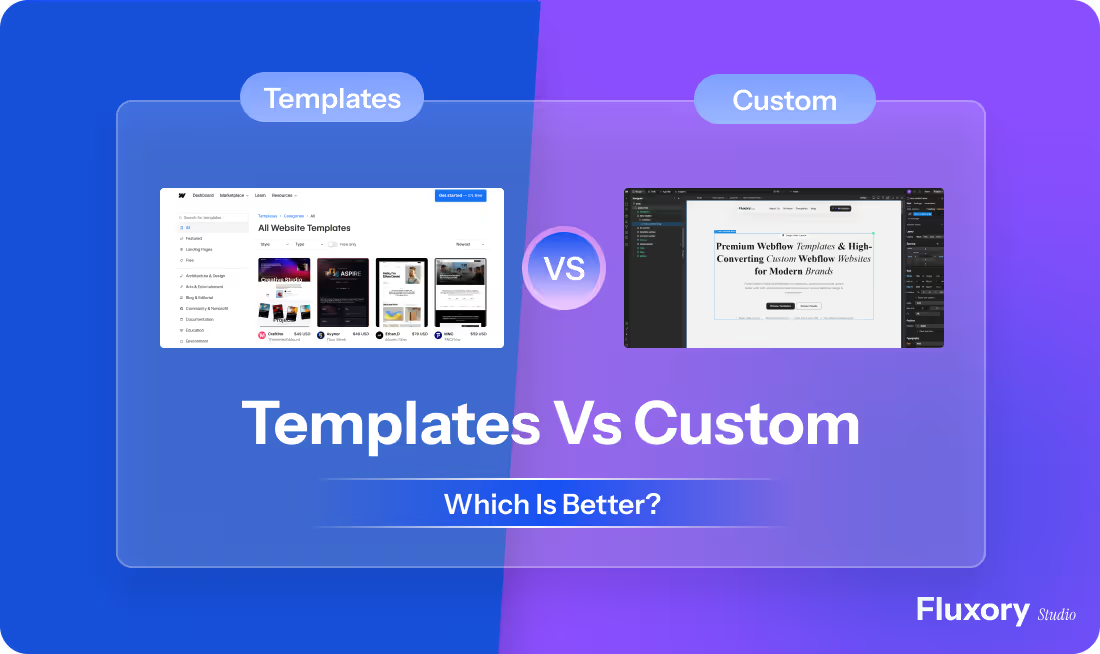
If you are deciding between Webflow templates vs custom Webflow design, you are really deciding how much flexibility, speed, and personalization your website needs. Both options are powerful, but they solve different problems. In 2026, choosing the wrong approach can cost you time, money, and future scalability.
This guide is written to help you make a clear decision, not to confuse you. Whether you are a founder, agency owner, or creator, by the end of this article you will know exactly which option is worth paying for in your case.
Before going into details, here is a clear side by side comparison to set expectations.
| Factor | Webflow Templates | Custom Webflow Design |
|---|---|---|
| Cost | Lower upfront | Higher upfront |
| Launch speed | Very fast | Slower |
| Design uniqueness | Semi-custom | Fully custom |
| Scalability | Good for most sites | Best for complex needs |
| Best for | Startups, agencies, creators | Brands, SaaS, enterprises |
| Maintenance | Easy | Easy but structured |
This comparison shows that the decision is not about good vs bad. It is about fit.
The difference between Webflow templates and custom Webflow design is not quality. It is intent.
Webflow templates are professionally designed layouts that you customize to fit your brand. The structure already exists, which saves time and reduces cost.
Custom Webflow design starts from a blank canvas. Every layout, interaction, and content flow is designed specifically for your business goals.
Both are built on the same platform. The value comes from how much customization and strategy you actually need.
Webflow templates are ideal when speed and efficiency matter more than starting from scratch.
If you need to launch quickly, templates give you a strong design foundation without long development cycles. They are especially effective for startups validating ideas, agencies building multiple client sites, and creators who want professional results without heavy investment.
Templates also reduce decision fatigue. Layouts, spacing, and UX patterns are already tested. You focus on content, branding, and conversions instead of structure.
For most marketing websites, portfolios, landing pages, and even many SaaS sites, Webflow templates provide more than enough flexibility.
Webflow templates can feel limiting if your website requires highly specific user flows, advanced interactions, or a design language that does not fit within existing structures.
If you find yourself constantly fighting the layout instead of customizing it, that is usually a sign that a custom design would serve you better.
Templates work best when adapted, not forced.
Custom Webflow design is worth paying for when your website is a core business asset.
If your brand depends on differentiation, storytelling, or complex user journeys, custom design gives you full control. This is common for SaaS companies, funded startups, and established brands that want to position themselves clearly in competitive markets.
Custom design also scales better when your website will grow in complexity over time. Instead of adjusting a prebuilt structure, everything is designed with your future in mind.
The tradeoff is time and investment, but the payoff is alignment.
Custom design is not always the smartest starting point.
If your site is simple, your budget is limited, or you need to launch quickly, custom design can slow you down without adding real value. In these cases, templates often deliver better results faster.
Choosing custom design too early can lead to unnecessary complexity.
If you need to launch fast and look professional, choose Webflow templates.
If your website must express a unique brand or product experience, choose custom Webflow design.
In most cases, templates are the right starting point. Custom design becomes valuable when complexity demands it.
From an SEO standpoint, both approaches perform well when built correctly.
Webflow templates already follow clean structure, responsive layouts, and fast-loading practices. Custom designs offer more control, but require disciplined execution.
SEO success depends more on strategy and content than whether the site is template-based or custom.
In 2026, websites are expected to be faster, cleaner, and easier to maintain.
Webflow templates are evolving to be more modular and scalable, making them a strong long-term option for growing businesses. Custom Webflow design is becoming more strategic, focusing less on visuals alone and more on conversion and user experience.
The future favors flexibility without unnecessary complexity, which is why choosing the right approach now matters.
The question of Webflow templates vs custom Webflow design does not have a universal answer.
Webflow templates are worth paying for when you want speed, efficiency, and professional design without heavy investment. Custom Webflow design is worth paying for when your website needs to support a unique brand, product, or growth strategy.
The smartest decision is choosing what fits your current stage and upgrading only when it truly adds value.
One email a month. New templates, and notes on shipping faster.
.svg)

.svg)

.svg)

.svg)


.png)
© Fluxory Studio 2026. All rights reserved

.png)


